
Palestinian Symbols and Their Meanings: A Guide
Posted by Mai Wazani on 18th Oct 2026
Some of the most powerful things in Palestinian life are small enough to hold in your hand: a fruit, a scarf, a key, a stitch.
They have been carried through exile, painted on walls, stitched into dresses and handed down in families. This is a guide to eight of them: where they come from, what they mean, and the stories people tell about them.
The Palestinian flag
Black, white and green in three bands, with a red triangle at the hoist. These are the pan-Arab colours, and the design goes back to the flag of the Great Arab Revolt of 1916. The Palestine Liberation Organization adopted it in 1964, and it became the flag of the Palestinian national movement.

After 1967, under Israeli military rule, showing the flag was restricted, and for years raising it carried a risk. It has never stopped meaning what it means. You will still see it at marches, on walls, and in the hands of people who have never set foot in Palestine.
The watermelon
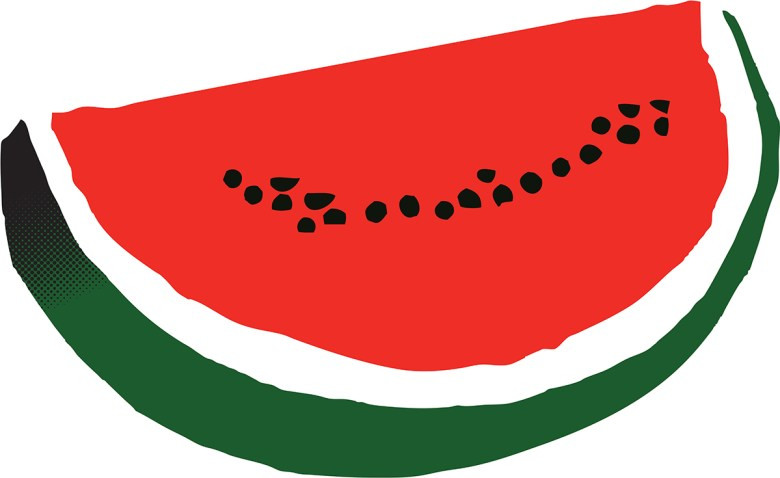
Cut one open and you see red, green, black and white: the colours of the flag. That is how a summer fruit became a symbol.
The story most often told goes back to 1980, when the painter Sliman Mansour and two fellow artists had an exhibition in Ramallah shut down by the Israeli army. The officer told them the flag and its colours were forbidden, and that even a painted watermelon would be confiscated. As Mansour has said, the watermelon came from the officer, not from the artists. Artists took it anyway. Today it appears on pins, murals and posters, and online as a single emoji. Read the full story of the watermelon.
Handala
A barefoot ten-year-old refugee, hair standing on end, hands clasped behind his back. Handala was drawn by the Palestinian cartoonist Naji al-Ali, who first published him in 1969. Al-Ali said Handala would stay ten until he could go home.
From 1973 he is drawn from behind: a witness who has seen enough and is waiting for something worth turning around for. His name comes from the handhal, or colocynth, a bitter plant that grows back every time it is cut. Al-Ali was shot in London in 1987, but Handala is still here. Read what Handala means.
The keffiyeh
It began as a farmer's scarf, worn against the sun and the dust, and became a symbol of the Palestinian national movement during the Palestinian Arab Revolt of 1936 to 1939. By the 1960s it was on the shoulders of Palestinian fighters and leaders, and Yasser Arafat carried it onto the world stage.

The black-and-white pattern carries three stories. The fishnet speaks of the sea and the fishing communities of the coast, the olive leaves of endurance and attachment to the land, and the bold lines of the trade routes that crossed Palestine. Read what the keffiyeh pattern means.
The olive tree
Olive trees are woven into Palestinian life: food, income, harvest, memory. Some are said to be hundreds of years old, and they can outlive the people who planted them, which is why they stand for peace, endurance and a deep attachment to the land.
Every autumn, families and neighbours still head out to the groves to pick. The olive tree is also bound up with sumud, the Arabic word for steadfastness: sustaining life, identity and a connection to the land through hardship. Read about sumud.
The key
In 1948, around 750,000 Palestinians fled or were expelled from their homes during the Nakba. Many took their house keys with them, expecting to go back. Those keys were kept, and handed down through the generations.

The key has become the symbol of the right of return. It holds the memory of a home and the claim to return to it, and it weighs even more now that so many of those homes, and whole villages, no longer stand. Giant keys stand at the entrances of refugee camps such as Aida, in Bethlehem. Read about the right of return.
Tatreez
Tatreez is Palestinian embroidery: the stitching that covers dresses, shawls and cushion covers in tight, colourful patterns, often worked in cross-stitch alongside other techniques such as couching. Motifs and colours often differed from one village to the next, so a woman's dress could tell you where she came from. Many patterns take their names from the world around them: cypress trees, stars, birds, flowers.
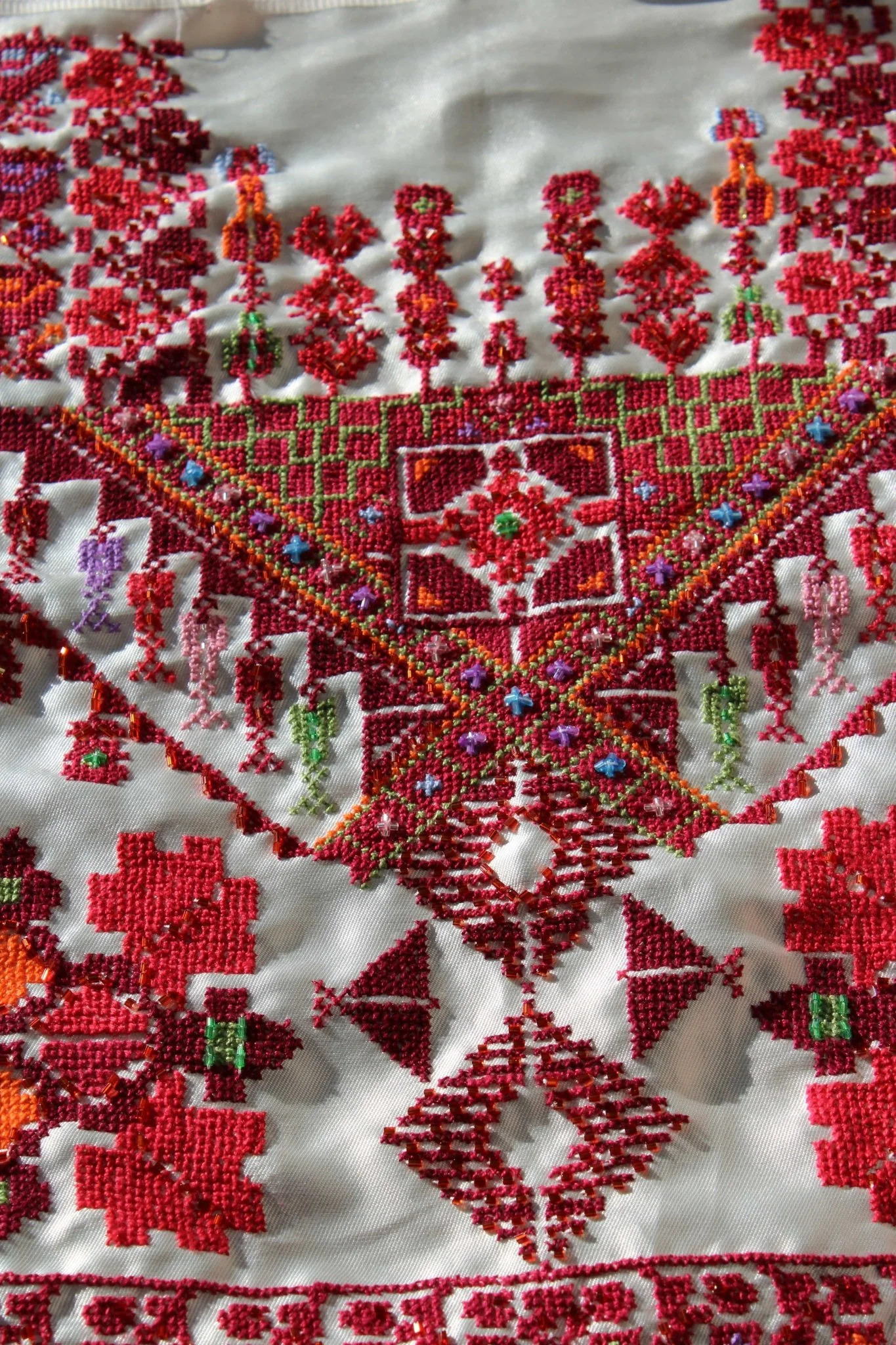
In 2021, UNESCO inscribed Palestinian embroidery practices on its Representative List of the Intangible Cultural Heritage of Humanity. After 1948, tatreez also became a way of keeping the memory of lost villages alive in the diaspora, one stitch at a time.
The cactus
Walk through the sites of Palestinian villages that were emptied in 1948 and you will often find a prickly pear cactus still standing. Known in Arabic as sabr, it was planted as a hedge around homes and fields, and it outlasted many of the houses. Sabr is also the Arabic word for patience, so the cactus has come to stand for resilience and for waiting, and for the memory of villages that are no longer there.
Why these symbols matter
Symbols carry identity and memory when words are hard to say. A flag, a fruit, a scarf, a cartoon child, a tree, a key, a stitch, a cactus: each is simple enough to recognize at a glance, and strong enough to hold a whole history. They keep a story alive for people who have never visited Palestine, and for those who were made to leave it.
How to wear them with respect
A symbol is not a costume. It carries a memory that belongs to people who lived it, and a little care goes a long way. Learn the story before you wear it or share it. Credit where it comes from: Palestinian artists, makers and storytellers. And support the people behind it, whether through a donation, a Palestinian-owned business or a brand that gives back.
Carry the story with you
Many of these symbols are part of our range. The flag lives on in our Palestine flag braided bracelet, and the watermelon in the watermelon collection. Handala is in the Handala necklace and the Handala enamel pin, the keffiyeh in the Keffiyeh Man hoodie, and the olive tree in the Olive Tree Don't Bend hoodie. The key is in the Key of Return necklace, and tatreez on our tatreez ceramic coaster.
Every order sends 10% to the Palestine Children's Relief Fund (PCRF), a charity providing medical care to Palestinian children.
About the author — Mai Wazani, Founder of Butterfly Krafts
Mai Wazani is a Palestinian activist and the founder of Butterfly Krafts, a Canadian brand rooted in cultural solidarity and diaspora identity. Born from a deep connection to Palestinian heritage, she built Butterfly Krafts in 2021 to channel activism into everyday wear — ensuring that every purchase directly supports Palestinian children through the Palestine Children's Relief Fund. Her writing explores the culture, symbols, and stories that keep Palestinian identity alive across the diaspora.