
Watermelon Symbol Meaning: Why It Represents Palestine
Posted by Mai Wazani on 28th Aug 2024
Slice one open and it is all there: red, green, black and white. The colours of the Palestinian flag, hiding inside a summer fruit.
That small coincidence has made the watermelon one of the best-known symbols of Palestine. It turns up on pins and posters, in murals and at marches, and online, where a single emoji can say what a paragraph cannot. Here is where the symbol comes from, and why it stuck.

What the watermelon means
On the surface, it is simple. The red flesh, the green rind, the black seeds and the white pith match the four colours of the Palestinian flag. And the watermelon is a fruit of the Palestinian summer, grown across the West Bank and Gaza, so it carries a taste of home along with its message.
Underneath, it stands for what the flag stands for: resistance, resilience, unity, and pride in being Palestinian. It lets people say all of that without raising a single flag.
The officer and the painter
After 1967, with the West Bank and Gaza under Israeli military rule, showing the Palestinian flag was restricted. Artists felt it keenly. In 1980, the painter Sliman Mansour and two fellow artists, Nabil Anani and Issam Badr, had their exhibition at 79 Gallery in Ramallah shut down by the Israeli army.
Mansour has told what happened next many times. The officer told them the flag was forbidden, and so were its colours. Badr asked what would happen if he painted a flower in red, green, black and white. It would be confiscated, the officer said. Even a watermelon would be confiscated.
The watermelon, as Mansour has said himself, came from the officer, not from the artists. But once the idea was out in the world, artists took it and made it theirs.
The artists who painted it
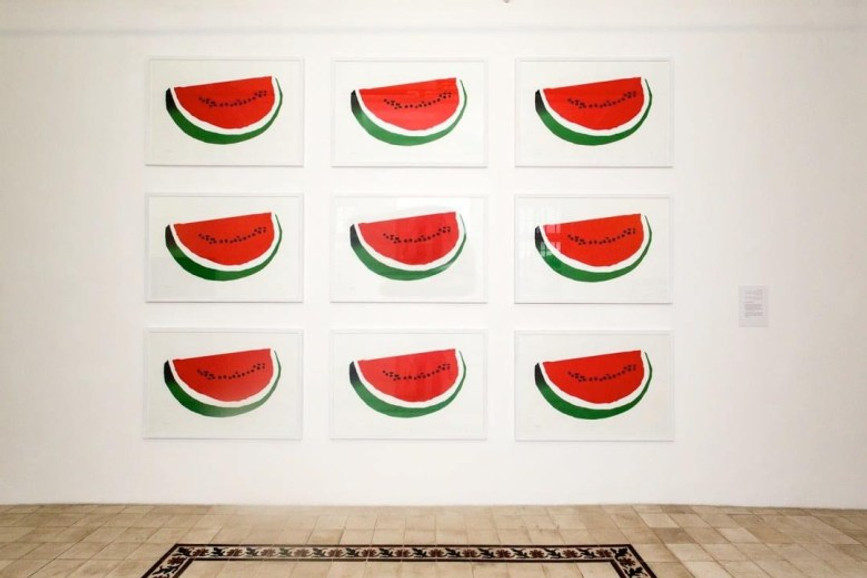
Painters and printmakers have been returning to the watermelon ever since. Mansour painted one in 1987 for a book of Palestinian folk stories. In 2007, Khaled Hourani made a watermelon silkscreen for the Subjective Atlas of Palestine, and later turned one of those prints into The Colours of the Palestinian Flag, the image above. Each of them, in their own way, used a slice of fruit to say what could not be said out loud.
How it travelled
For a long time the watermelon belonged mostly to artists. Then it went online. People began sharing the watermelon emoji, drawings and hashtags to stand with Palestine, and from there it spread to marches, murals, tote bags and tattoos far beyond Palestine. A symbol that began with a conversation between an officer and a painter now lives on phones and placards all over the world.
What it means today
The watermelon is no longer only a way around a rule. It is a way of belonging. When someone pins one to a bag or posts one under a message, they are saying that they see what is happening, and that they are not looking away. It is easy to recognize and easy to share, and it carries a whole history in the shape of a slice of fruit.
Wear the watermelon
If you would like to carry it with you, explore our watermelon collection: the Palestine watermelon pins, the watermelon pendant necklace and the watermelon art canvas tote bag. Every order sends 10% to the Palestine Children's Relief Fund (PCRF), a charity providing medical care to Palestinian children.
The watermelon is one of several symbols that hold Palestinian memory. You might also like the story of Handala, the barefoot child with his back turned, and what the patterns on the keffiyeh mean.
The watermelon is one of eight symbols in our guide to Palestinian symbols and their meanings, alongside the flag, Handala, the keffiyeh and more.
About the author — Mai Wazani, Founder of Butterfly Krafts
Mai Wazani is a Palestinian activist and the founder of Butterfly Krafts, a Canadian brand rooted in cultural solidarity and diaspora identity. Born from a deep connection to Palestinian heritage, she built Butterfly Krafts in 2021 to channel activism into everyday wear — ensuring that every purchase directly supports Palestinian children through the Palestine Children's Relief Fund. Her writing explores the culture, symbols, and stories that keep Palestinian identity alive across the diaspora.