
Keffiyeh Pattern Meaning: Fishnet, Olive Leaves, Trade Routes
Posted by Mai Wazani on 28th Oct 2025
It started as a scarf for the sun and the dust. It became one of the most recognizable pieces of cloth in the world.
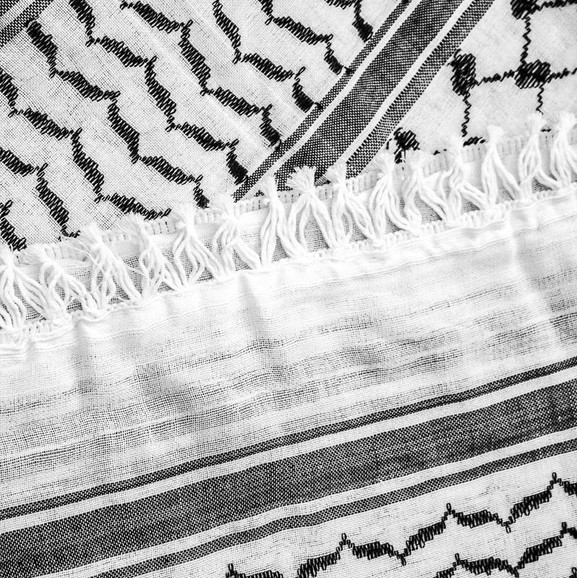
Look at a Palestinian keffiyeh and you will find three patterns woven into it: a fishnet, a border of leaves, and bold lines. Each one carries a story, and people tell those stories with pride. This is what they say, and how a farmer's scarf came to stand for a whole people.

Where the keffiyeh comes from
The keffiyeh began as everyday clothing. Palestinian farmers and shepherds wore it against the sun, the wind and the dust.
Its life as a symbol begins with the Palestinian Arab Revolt of 1936 to 1939, when wearing one became a sign of unity and resistance. By the 1960s it was worn by Palestinian fighters and leaders, and Yasser Arafat, who was rarely seen without one, carried it onto the world stage.
The fishnet

The fishnet weave speaks of the sea. It calls up the Mediterranean coast and the fishing communities who have lived along it, and the Sea of Galilee too. It is the pattern of livelihood, passed from one generation to the next. In Gaza, fishermen still work under limits on how far they may sail, which is part of why the sea means what it does today.
The olive leaves

Around the border run the leaves of the olive tree. Olive trees are woven into Palestinian life: food, income, harvest, memory. They can live for hundreds of years and keep bearing fruit, which is why they have come to stand for peace, endurance and a deep attachment to the land. Many olive growers in the West Bank still struggle to reach their groves.
The bold lines

The thick lines are read as the trade routes that crossed Palestine, linking the Mediterranean to Arabia, Egypt and lands further east. They are a reminder that this was always a crossroads, a place where goods, ideas and people passed through for thousands of years.
Black and white, or red and white
Not every keffiyeh is the same. The black-and-white one is the one most closely tied to Palestine. Red-and-white versions are common in Jordan, and other places have their own colours and weaves. When people say the Palestinian keffiyeh, this is the one they mean.
Wearing it today
You will see keffiyehs at marches, in classrooms, on stages, and on shoulders in every city with a Palestinian community. Wearing one is a quiet way of saying you stand with Palestinians.
It has also been picked up by fashion houses, and that is where something gets lost. When the pattern is sold without its story, it becomes just a print. If you wear one, know what it carries, and buy from people who do.
You will find the keffiyeh pattern across our range: the Keffiyeh Man hoodie, tote bags, ceramic coasters, mugs and jewellery. Every order sends 10% to the Palestine Children's Relief Fund (PCRF), a charity providing medical care to Palestinian children.
To wear the pattern in smaller ways, see the Keffiyeh Heritage Pendant Necklace or the Keffiyeh Pattern Map enamel pin.
The keffiyeh is one of several symbols that hold Palestinian memory. You might also like the story of the watermelon and the barefoot child named Handala.
The keffiyeh is one of eight symbols in our guide to Palestinian symbols and their meanings, alongside the flag, the watermelon, Handala and more.
About the author — Mai Wazani, Founder of Butterfly Krafts
Mai Wazani is a Palestinian activist and the founder of Butterfly Krafts, a Canadian brand rooted in cultural solidarity and diaspora identity. Born from a deep connection to Palestinian heritage, she built Butterfly Krafts in 2021 to channel activism into everyday wear — ensuring that every purchase directly supports Palestinian children through the Palestine Children's Relief Fund. Her writing explores the culture, symbols, and stories that keep Palestinian identity alive across the diaspora.